
Asian Studies
The Institute publishes a bi-annual journal titled Asian Studies, which showcases original research on the themes central to the Institute’s mandate. The journal features contributions from the Institute’s faculty as well as distinguished scholars from across India and abroad. Asian Studies provides a platform for academic work on the Indian National Movement, the role of Netaji Subhas Chandra Bose and the Indian National Army, nation-building in South and South-East Asia, Asian relations, and ecological issues within the Indian and Asian context. It reflects the Institute’s commitment to promoting rigorous scholarship and encouraging informed dialogue on these critical areas of study.
A Multi-Disciplinary Journal of Asian Political, Economic, Cultural Affair and Natural and Human Resources Asian Studies, a bi-Annual Journal, has been published by the Netaji Institute for Asian Studies, since the year 1983, based on the following:
1. focuses attention on the social, political and economic developments of current interest and pertaining to the countries of Asia
2. contains occasional research papers of the academic staff of the Institute.
3. reports of the seminars, symposium, and other events held in the Institute from time to time.
4. acts as a means of intellectual exchanges with other research institutes in the country and abroad
5. publishes learned papers from scholars working elsewhere on problems and projects relevant to the research interest of the institute
6. initiates documentation series on materials relating to various aspects of the life and culture of the Asian people and
7. generally indicates the basic trends of co-operation taking place at different levels between the developing countries of Asia.
While the journal encourages responsible academic research on the lines suggested above, the opinions and findings of the contributing authors need not reflect the opinions or policies of the Institute as such.
Editorial Board
- Dr. Sugata Bose
- Dr. N. P. Bhaduri
- Dr. Suranjan Das
- Dr. Sumantra Bose
- Dr. Tansen Sen
- Dr. Soma Bandopadhyay
INFORMATION FOR CONTRIBUTORS
- “Asian Studies” the official organ of the Netaji Institute for Asian Studies, is a multi-disciplinary journal of Asian affairs. Papers based on original research on any relevant field are considered for publication. The language of the Journal is English.
- Manuscripts for publication should be submitted in duplicate, typed double-spaced on one side of opaque paper, or in the floppy diskette, to the Editor at the address of the Institute. Contributions will be acknowledged as soon as accepted.
- Papers submitted should not normally exceed 10,000 words (about 30 pages typed as specified above) including equivalent space for tables and diagrams, if any.
- Contributions should be accompanied by: (a) an abstract or summary within 120 words; (b) a biographical sketch of the author(s) within 50 words; (c) the author’s current address and institutional affiliation; (d) if the author’s institution requires permission for publication, documents granting such permission.
- References should be cited in the text with serial numerical superscripts and all references, annotations etc. listed at the end of the paper in corresponding order. Papers and articles cited should be identified by the author, title, name of the journal, year and inclusive pages; books referred to should be identified by author, title, place of publication and name of publisher and year. Specific references should include selected page numbers. Papers are not to be accepted if the -specifications (given above) are not followed.
- Tables should be carefully prepared so that the printer can easily follow the copy. Tables must only replace or supplement text, without duplication.
- Line diagrams can be included only if essential. Diagrams prepared should be so designed as to stand 2/3 reduction for printing within the size of the page. Diagrams should be restricted to the minimum essential. While sending the papers in the first instance, the contributors are advised to include only photocopies of diagrams pertaining to the papers. The original may be sent only after the paper/papers are formally accepted for publication. In case larger or more numerous illustrations are necessary, authors may have to contribute towards the cost of making blocks.
- Papers should be concise, lucid, well documented, academic in tenor and consistent with the scope of the Journal. The opinion of the Editorial Board regarding acceptability will be final. If any modifications are suggested, final acceptance will be contingent on these being carried out. The right to effect necessary editorial improvement is reserved.
- Contributors will be supplied 10 offprints free of cost.
No material published here may be reproduced in any form without the prior permission of the publisher.
Views and opinions expressed in the journal are those of the authors. The Institute accepts no responsibility in this regard.
Correspondence on editorial, subscription and other matters may be addressed to
The Editor, Asian Studies, 1, Woodburn Park, Kolkata 700020, India.
Please write to: The Director, Netaji Institute for Asian Studies, 1, Woodburn Park, Kolkata – 700 020, Phone: 2287-3145/2283-5079, E-mail: netajiinstitute1981@gmail.com
Recent Issues
Archives
Vols. XLI (January 2023-December 2023)
Sarvani Gooptu, ‘Calcutta as the focal point of re-discovery of Buddhism in Colonial India’
Amit Mishra, ‘Russo-Ukrainian War and the Emerging World Order’
Anup Shekhar Chakraborty, ‘Exploring the Politics of Sexualities and Pink Migrations among Gorkhas in North-Eastern India’
Shriya Dasgupta, ‘From Sanatan Dharma to Communism: Tracing the Ideological Transformation among Bengali Revolutionaries’
Vols. XXXX (January 2022-December 2022)
- Sarvani Gooptu, ‘New’ Pilgrimage: Asian Connectivity Through Tourism and Awakening of National Pride
- Anup Shekhar Chakraborty, ‘The Raj, Missionaries, and Medicalisation among the Zo hnahthlak’
- Susmita Mukherjee, Christian Missionaries In Burma: Challenges and Responses of the Pioneer American Baptist Missionary Adoniram Judson (1813-1850)’
- Sandip Halder, ‘Study of Wetlands in and Around Kolkata: An Appraisal’
- Srikrishna Mandal, ‘The Hill Kharia Ethnic Identity and Ecology in Purulia District in West Bengal’
- Adrija Roy, ‘India’s Stance on Climate Change Debates’
Vols. XXXIX (January 2021-December 2021)
- Sarvani Gooptu, ‘At the Warfront during the Mesopotamian Campaign in 1914-1918: Soldier’s Reminiscences in Bengali periodicals’
- Anup Shekhar Chakraborty & Anjan Chakrabarti, ‘Colonial Forest Policies, Forests And Graziers in Darjeeling, Kurseong and Kalimpong’
- Susmita Mukherjee, ‘Dr. Ma Saw Sa: The First Lady Doctor and Parliamentarian of British Burma (1884-1962)’
- Mimasha Pandit, ‘Melodramatizing History/Historicizing Melodrama: Interrogating the Role of Historical Soap Operas in Creating an Alternative Historical Narrative’
- Nandan Dasgupta, ‘The Travelling Rāmāyana – Tamil & Telugu Sources of Michael Madhusudan Datta’s Meghnādbadh Kāvya (1861)’
- Udayan Das & Ambar Kumar Ghosh, ‘South Asian Regional Identity: Exploring Alternative Imaginations’
- Paulomi Mallick, ‘The Role of Dalit Women against Land Acquisition in South Asia: A Study in Politics at Singur, West Bengal’
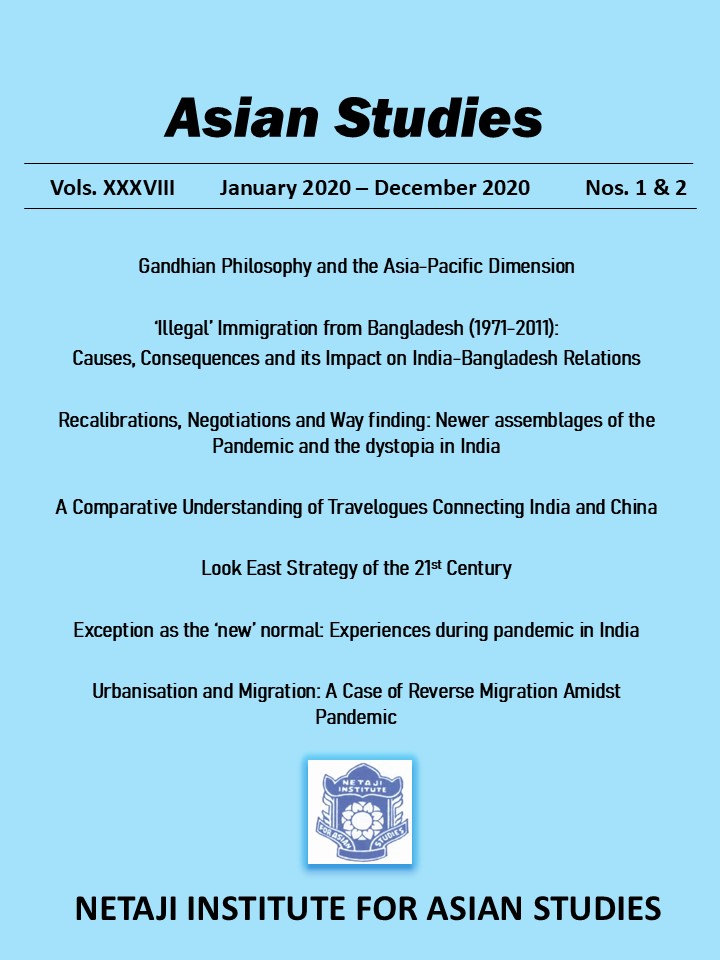
Vols. XXXVIII (January 2020 - December 2020
- Sarvani Gooptu, ‘Gandhian Philosophy and the Asia-Pacific Dimension’
- Anup Shekhar Chakraborty, ‘Recalibrations, Negotiations and Way Finding: Newer Assemblages of the Pandemic and the Dystopia in India’
- Barnali Chandra, ‘A Comparative Understanding of Travelogues Connecting India and China’
- Subhadeep Bhattacharya, ‘Look East Strategy of the 21st Century’
- Madhurilata Basu, ‘Exception as the ‘new’ Normal: Experiences during Pandemic in India’
- Rippy Das, Kabindra Sharma & Sanghamitra Choudhury, ‘Urbanisation and Migration: A Case of Reverse Migration Amidst Pandemic’
Vols. XXXV (January 2017-December 2017), Nos. 1 & 2
- Sarvani Gooptu, ‘Crossing the Threshold into the World: Travel Narratives by Bengali Women in the 20th Century’
- Anup Shekhar Chakraborty, ‘Claims-Making, Connections and Contests over the Trans-Himalayan ‘Shared Heritage’ of ‘Gorkha’ in South Asia’
- Vivek Mishra, ‘Changing Shades of India’s Multilateralism’
- Supreeta Mehta, ‘Diplomacy Through the Ages: A Case Study’
- Nandini Bhattacharya, ‘Indo-Tajik Cultural Link: A Musical Journey Through the Past and Present’
- Karubaki Datta & Deepika Chettri, ‘Change and Continuity: Preserving the Cultural Heritage of Tibet in Era of Diaspora’
Vols. XXXIV (January 2016-December 2016), Nos. 1 & 2
- Nrisinha Prasad Bhaduri, ‘Rama the Culture – Hero and his Human Face’
- Sarvani Gooptu, ‘Mapping Asia for Children: Pedagogy and Nationalism in Sandesh (1913-1926)’
- Anup Shekhar Chakraborty, ‘Localisation of the Gospel, Cultural Revivals and Christianity: Colonial Encounter in South Asia and the Zo Hnahthlak’
- Susmita Mukherjee, ‘Burma-Bengal Connectivity: Bengali Revolutionaries Carving a Space in Burma to Strike at British Colonial Oppression at Home’
- Tridib Chakraborti, ‘Mahatma Gandhi: The Relentless Peacemaker of Human Civilization’
- Purusottam Bhattacharya, ‘Brexit: Implications for India’
- Vivek Mishra, ‘Implications for Asia of Donald Trump’s Victory’
- Sandip Halder, ‘Landslide in Darjeeling Hill Areas: A Study of Some Selected Areas in Kurseong’
Vols. XXXII-XXXIII (January 2014-December 2015), Nos. 1 & 2
- K. Chatterjee, ‘Migration and Infiltration in the Indian Context’
- Surojit Sen Gupta, ‘A Study of Panchayati Raj Institution and its Developmental Activities in Tripura – An Overview’
- N. Satpati, ‘Hydro-Geomorphic Concerns for Urban and Transport Planning in West Bengal’
- Lopamudra Ganguly, ‘Water Conservation in India: An Ancient Concept to Future Practice’
- Rajat Halder, ‘Population Growth and Related Problems in North 24 Parganas District, West Bengal’
- Moumita Ghosh, ‘Development and Marginalization – A Case Study’
- Shalmoli Bhattacharya, ‘Gender Discrimination and Harassment at Place of Work’
- Book review by Palash Chandra Coomar, for Manis Kumar Raha (ed.), North East India: The Human Landscape, Concept Publishing Company (Pvt.) Ltd., New Delhi, 2014
- Book review by Manis Kumar Raha, for R. K. Das Chowdhury, Socio-Economic Scenario of the North East India, Concept Publishing Company (Pvt.) Ltd., New Delhi, 2013
- Book review by Manis Kumar Raha, for K. C. Kabra, Economic Growth of Mizoram: Role of Business and Industry, Concept Publishing Company (Pvt.) Ltd., New Delhi, 2008
Vol. XXXI (July -December 2013), No. 2
- N. Bose, ‘In Search of INA Heroes in South East Asia-October 2012’
- Ananda Bhattacharyya, ‘Sitaram’s Autobiography: A Tale of Loyalty’
- Anjali Ghosh, ‘India’s ‘Look-East Policy’ and Emerging Prospects for West Bengal: An Introduction’
- Indrita Saha & Ashis Sarkar, ‘Disparity in Development of Mouzas of Binpur-I Block, West Bengal – A Geoinformatics Approach’
- Mamata Desai, ‘Disaster Management – Indian Scenario’
- Abhijit Das, ‘A Systematic Review of Groundwater Arsenic Pollution Problem in Two Asian Countries: Bangladesh and India’
- Arpita Bose, ‘History of the Chinese in Calcutta – An Overview (1781-1950)’
- Prosenjit Mukherjee, ‘Emerging Changes of Seasonal Tenancy Relations during Boro Cultivation in West Bengal Agriculture since 1990s: A Study of Reverse Tenancy’
- Sandip Halder, ‘Urban Poor: A Study on Livelihood Situation of some Underprivileged Groups of Slum in KMC Area’
- Aparna Banerjee & Uttam Kumar Bhattacharya, ‘A Comparative Study between the Trade Performance of the Ports of Australia and India’
- Subir K. Kole, ‘Are Development and Cultural Preservation Compatible Objectives? An Inquiry into the Public Health Care in India’
- Anwesha Haldar, ‘State of Solar Energy Development in the Sundarban Region: A Micro-level Study in Gosaba, West Bengal
- Naparajit Mukherjee, ‘A Note on the Khaksar Movement in India’
- Book review by Manis Kumar Raha, for H. S. Pomeroy, The Ethics of Marriage, Logos Press, New Delhi, 2013
- Book review by Manis Kumar Raha, for Vineeta Menon (ed.), Environment and Tribes in India: Resource Conflicts and Adaptation, Concept Publishing Company (Pvt.) Ltd., New Delhi, 2012
- Book review by Manis Kumar Raha, for Gautam Kumar Bera, Religion and Society in Sovereign Tripura, Abhijeet Publications, New Delhi, 2012
Vol. XXXI (January -June 2013), No. 1
- Purusottam Bhattacharya, ‘Political Relations Between India and the European Union: Convergences and Divergences on some Major Contemporary International Issues: Afghanistan and the Arab Spring’
- Sarajit Kumar Chatterjee, ‘Role of Caste in the Indian Polity’
- Apurba Kr. Mukhopadhyay, ‘Trajectories of India’s Developmentalist State: From Decolonization to Recolonization (?)’
- Mahua Bardhan, ‘Present Scenario of a Tribal Community in West Bengal: A Case Study of Endangered Primitive Tribe ToTo in Jalpaiguri District’
- Aparna Banerjee and Uttam Kumar Bhattacharya, ‘Ports and Urbanization in Colonial India’
- Ajay Debnath, ‘Integrated Model of Weather Warning System for Vulnerable Areas: A Case Study of Gosaba C. D. Block in the Sundarban Region’
- Book review by Manis Kumar Raha, for M. S. Mahendrakumar, Audio-Visual Anthropology, Concept Publishing Company (Pvt.) Ltd., New Delhi, 2013
- Book review by Manis Kumar Raha, for Pranjal Boruah, Healthcare Practices Among the AO Nagas: Socio-Cultural Study of Nagaland, Concept Publishing Company (Pvt.) Ltd., New Delhi, 2012
Vol. XXX (July - December 2012), No. 2
- Prabir Kr. De, ‘Urbanization in West Bengal: Post-Colonial Development’
- Manis Kumar Raha, ‘Agony and Ecstasy: Expression of Sentiments Through Tribal Songs’
- N. Satpati, ‘Eco-Tourism: Prospect of Development in West Bengal’
- Debajyoti Banerjee, ‘The Politics of Reading: Some Controversies’
- Surojit Sen Gupta, ‘Vocational Education and Vocational Guidance – The Need of the Present Day Society’
- Sujit Mandal & Ramkrishna Maiti, ‘As Assessment of Human Intervention Induced Slope Instability: A Case Study of the Shiv-Khola Watershed of Kurseong Sub-division, Darjiling Himalaya’
- Anuj Kanchan Datta Roy, ‘Questioning Human Rights of Women in Tripura’
- Book review by Debnarayan Modak, for Mohit Bhattacharya, Subhas Chandra Bose As city Manager, K. P. Bagchi & Co., Kolkata, 2012.
- Book review by Gopalkrishna Chakrabarti, for Falguni Chakrabarty, Adaptation of the Santals to the Hill-Forest Environment, APH Publishing Corporation, New Delhi
- Book review by Manis Kumar Raha, for M. V. Rao, Persistence and Change in Tribal India, Concept Publishing Company (Pvt.) Ltd., New Delhi, 2012
- Book review by Manis Kumar Raha, for Bhagyalaxmi Mahapatra, Development of a Primitive Tribe, Concept Publishing Company (Pvt.) Ltd., New Delhi, 2011
- Book review by Manis Kumar Raha, for S. A. Azeez Saheb, B. Francis Kulirani & K. K. Misra (eds.), Cultural Pluralism: The Indian Scenario, Concept Publishing Company (Pvt.) Ltd., New Delhi, 2012
Vol. XXX (January -June 2012), No. 1
- Anirban Banerjee, ‘The Contribution of Reverend Lal Behari Das to the Study of Bengali Folklore’
- Anindya Batabyal, ‘Stapled Visas and Sino-Indian Bilateral Ties’
- Pradipta Dubey & Atonu Chatterjee, ‘Marketing the Products of Self Help Group: A Study of North 24 Parganas, West Bengal’
- Yaqoob Ul Hassan, ‘Balochistan: Now and Then’
- Susanta Pramanik & Sandip Halder, ‘Analysis of Geo-Hydrophysical Characteristics of Aquifers of Balasore-Bhadrak Coastal Zone – A Case Study’
- Debasree De, ‘Evaluating Forest Rights Act of 2006’
- Book review by Manis Kumar Raha, for Komol Singh, Economy of a Primitive Tribal Village in Manipur, Concept Publishing Company (Pvt.) Ltd., New Delhi
- Book review by Manis Kumar Raha, for K. E. Rajpramukh, Tribal Health in Eastern Ghats Centre, Concept Publishing Company (Pvt.) Ltd., New Delhi, 2012
- Book review by Manis Kumar Raha, for K. N. Jena and Habu Dhan Tripura, Life and Customary Laws of Tripura Tribes, Abhijeet Publications, New Delhi, 2009
Vol. XXIX (July - December 2011), No. 2
- Jyotiskona Barik, Pranabes Sanyal & Sugata Hazra, ‘Sustainable Development of Algal Culture in Relation to Socio-Economy in Sundarbans’
- Moumita Moitra Maiti, ‘Social Consequences of Water Scarcity in Darjeeling, West Bengal’
- K. Biswas, ‘Status of Tribal Women in Andaman & Nicobar Islands’
- Samhita Chaudhuri, ‘Rain Water Harvesting as a Measure for Water Resource Management in Hilly Towns: A Key Towards Sustainable Urban Development in India’
- Apurba Kr. Mukhopadhyay, ‘Coffee House in a Paddy Field’: In Search of a Utopian Civil Society?’
- N. Satpati, ‘Chinese Hegemony in Geopolitics of the Himalayan Region’
- Gautam Kumar Basu, ‘The Naxalite Movement: A Detached Observation’
- Mahuya Roy Karmakar, ‘Domestic Violence and Dowry Dismissive Attitudes Towards Women in India’
- Book review by Manis Kumar Raha, for Nemthianngai Guite, Indigenous Medicine and Health Care Among Paite Tribe of Manipur, Concept Publishing Company (Pvt.) Ltd., New Delhi, 2011
- Book review by Manis Kumar Raha, for Ashim Kumar Adhikary, The Tribal Situation in India: Structure, Change and Continuity, Abhijeet Publications, New Delhi, 2009
- Book review by Manis Kumar Raha, for Bhagyalaxmi Mahapatra, Ethnic Dances and Music of Western Orissa: An Anthropological Study Towards Promoting Eco-Tourism, Concept Publishing Company (Pvt.) Ltd., New Delhi, 2011
- Book review by Manis Kumar Raha, for Goutam Kumar & K. Jose, Ethno-Social Mobility in North-East India, Abhijeet Publications, New Delhi, 2010
Vol. XXIX (January – June 2011), No. 1
- James Mayall, ‘The Impact of China and India on International Society’
- Nikhilesh Das, ‘Economic Growth and Social Responsibility’
- Surojit Sen Gupta, ‘Urban Scene in North-East India’
- Atonu Chatterjee, ‘Microcredit in India – The God that Failed?’
- Sudeepta Ghose, ‘Rethinking the Battle of Plassey: Prologue and Epilogue’
- Rahi Soren and Parthiba Basu, ‘Ecological Resilience along a Forest Fire Gradient in the Dry Deciduous Forest of Bankura, West Bengal, India
- Mun Mun Nandy, ‘Changing Patterns of Livelihood: A Case Study of the Santhal Community of Selected Wards of Bansberia Municipality, Hooghly District’
- Manis Kumar Raha, ‘Edward Westermarck and The Institution of Marriage’
- Book review by Manis Kumar Raha, for P. K. Sanjeev Reddy & P. C. Sekhar Reddy, Peace and Development in North East: A Virtuous Spiral, Mittal Publications, New Delhi, 2007
- Book review by Manis Kumar Raha, for Rup Kumar Burman, Contested Regionalism, Abhijeet Publications, New Delhi, 2007
- Book review by Manis Kumar Raha, for Gaya Pandey, Bio-Cultural Evolution, Concept Publishing Company (Pvt.) Ltd., New Delhi, 2010
- Book review by Manis Kumar Raha, for Asoka Kumar Sen, Representing Tribe: The Ho of Singhbhum under Colonial Rule, Concept Publishing Company (Pvt.) Ltd., New Delhi, 2011
Vol. XXVIII (July - December 2010), No. 2
- Naparajit Mukherjee, ‘Netaji – Certain Untold and Startling Facts’
- Shantanu Chakrabarti, ‘Securitizing South Asia: Quest for a Broader Regional Comprehensive Peace Building Agenda’
- Apurba Kumar Mukhopadhyay, ‘State and Civil Society: Dialogue Between the Deaf and the Dumb in India’
- Sanjay Kumar Pradhan, ‘Socio-Economic Problems of the People of Indian Origin in Post-Apartheid South Africa: An Analysis’
- Abdullah Al-Masum & Dr. Noor Shakirah Mat Akhir, ‘Environmental Education in Bangladesh: Policy, Awareness and Movement (1974-2009)’
- Biraj Kanti Mondal & Sukla Bhaduri, ‘Effect of Tiger Prawn Seeds Collection on the Ecosystem of Indian Sundarban’
- Soumyajit Chowdhury, Pranabes Sanyal, Sugata Hazra and Joydeep Mukherjee, ‘Ecological Contributions of Fiddler Crabs Towards the Sustenance of Sundarban Mangroves: A Biotic Influence in Disaster Management’
- Book review by Kingshuk Chatterjee, for Debnarayan Modak (ed.), Terrorism: Concepts and Problems, Progressive Publishers, Kolkata, 2009
- Book review by Manis Kumar Raha, for Usha Sharma, Festivals in Indian Society (in two volumes), Mittal Publications, New Delhi, 2008
- Book review by Manis Kumar Raha, for H. N. Hutchinson, Marriage Rites, Customs and Ceremonies of the World, Logos Press, New Delhi, 2009
- Book review by Manis Kumar Raha, for Asha Mishra and Chittaranjan Kumar Pati (ed.), Tribal Movements in Jharkhand 1857-2007, Concept Publishing Company Pvt. Ltd., New Delhi, 2010
Vol. XXVIII (January – June 2010), No. 1
- Aswini K. Ray, ‘Democracy in the 21st Century: A Non-Western View’
- Rakhahari Chatterji, ‘Lok Sabha Elections, 2009 and Beyond’
- Apurba Kr. Mukhopadhyay, ‘Parliamentary Communism in India: Some Paradoxes and Puzzles’
- Prabir De, ‘Self-Help Group in West Bengal: Towards Participation, Governance and Human Rights’
- Surojit Sen Gupta, ‘Environmental Education in Tripura’
- Saptarshi Mitra, ‘Urban Settlements in West Bengal: Twentieth Century and After’
- Geetanjali Dutta, ‘Gender Inequality in India: An Analysis’
- Book review by Manis Kumar Raha, for T. B. Subba, Joseph Puthen Pwakal and Shaji Joseph Puykunnel (eds.), Christianity and Change in North-East India, Concept Publishing Company Pvt. Ltd., New Delhi, 2009
- Book review by Manis Kumar Raha, for Swapan K. Biswas, Colonization and Rehabilitations in Andaman and Nicobar Islands, Abhijeet Publications, New Delhi, 2009
- Book review by Manis Kumar Raha, for M. Romesh Singh, Tribal Development in 21st Century: An Experience from Manipur, Mittal Publications, New Delhi, 2006
Vol. XXVII (July - December 2009), No. 2
- Ashis Sarkar, ‘Particulate Pollution Scenario- An Environmental Analysis’
- Mitrajit Chatterjee, ‘Integrated Waste Management – The Need of the Hour (with special reference to West Bengal)’
- Priyank Pravin Patel, ‘Estimation of Land Surface Temperature from Landsat Thermal Images Towards Urban Heat Island Mapping of Kolkata’
- Sabyasachi Bose, ‘Hydro-Power Potentials in Nepal: The Biggest Hope for Future Economic Development and Indo-Nepal Co-operations’
- Mun Mun Nandy, ‘Urban Sprawl and Urban Planning in East Kolkata: A Study of Selected Wards of Kolkata Municipal Corporation’
- Book review by Manis Kumar Raha, for Y. P. Singh (eds.), Indian Villages: 2020 (two volumes), Concept Publishing Company Pvt. Ltd., New Delhi, 2006
- Book review by Manis Kumar Raha, for Bimal J. Deb, Keya Sen Gupta and B. Datta Ray (eds.), Globalisation and North East India, Concept Publishing Company Pvt. Ltd., New Delhi, 2008
- Book review by Mamata Desai, for Alf Hornborg & Carole L. Crumley (eds.), The World System and the Earth System – Global Socio-environmental Change and Sustainability since the Neolithic, PHL Learning Private Limited, New Delhi
- Book review by Manis Kumar Raha, for J. R. Subba, History Culture and Customs of Sikkim, Gyan Publishing House, New Delhi, 2008
Vol. XXVII (January – June 2009), No. 1
- Pradip Bose, ‘Netaji Subhas Chandra Bose’s Social Philosophy and Socio-Economic Ideas’
- Nikhilesh Das, ‘Environmental Management – A Concept’
- Prabir Kr. De, ‘Environmental Agenda in SAARC Countries’
- Alok Dutta, ‘India and Disarmament’
- Ayub Mallick, ‘Review of Electoral Politics in West Bengal, 1952-87: Growing Influence of the Left Forces and Disintegration of Congress’s Dominance’
- Apurba Kr. Mukhopadhyay, ‘The Boat is Rocked but not Upturned: Revisiting Marxist Parties of West Bengal’
- Soma Kundu, ‘Roles of Different Financial Avenues to Meet Healthcare Expenditure in Rural India’
- Ranjit Sen, ‘Higher Education: A Change in Perspective’
- Book review by Manis Kumar Raha, for Kamal K. Misra (ed.), Anthropology New Global Order and Other Essays, Concept Publishing Company Pvt. Ltd., New Delhi, 2005
- Book review by Manis Kumar Raha, for N. K. Panda, Policies, Programmes and Strategies for Tribal Development, Kalpaz Publications, Delhi, 2008
- Book review by Manis Kumar Raha, for Prem Singh Jina, Ladakh Buddhist Culture and Tradition, Kalpaz Publications, Delhi, 2006
Vol. XXVI (July - December 2008), No. 2
- Sanjay Kumar Pradhan, ‘Iranian Nuclear Dilemma and the United States’
- Manis Kumar Raha, ‘Safeguards and Facilities for Indian Tribes: Past and Present’
- Mamata Desai, ‘Issues of Livelihood Development in the Coastal Regions of West Bengal’
- K. Sikdar, ‘Indian Coastal Zone: Regulation or Management’
- Anway Mukhopadhyay, ‘The Enormous Symbolic Potentials of the Kali-Cult’
- Salma Sultana, ‘Sustainable Agricultural Development and Natural Resource Management in Mahanadi and Balason Basin, Darjeeling, West Bengal’
- Ratna Saha, ‘The Hill Kharias and their Environment’
- Book review by Manis Kumar Raha, for G. R. Madan, India and the West: A Cultural Contrast, Mittal Publications, New Delhi, 2004
- Book review by Manis Kumar Raha, for R. E. S. Tanner, Contemporary Social Science Research, Concept Publishing Company Pvt. Ltd., New Delhi, 2008
Vol. XXVI (January – June 2008), No. 1
- In Memorium: Professor Basudeb Chattopadhyay
- Chitra Ghosh, ‘A Pilgrimage to Moirang, Manipur’
- Amarjit Singh, ‘Muslim Communal Politics and Partition of India: A Historiographic Resume’
- Sanhita Mukherjee, ‘Landlords, the Imperial Power and National Awakening: The Role of the Kandi Raj Family’
- Ajanta Biswas, ‘The Communist Challenge in Indonesia: From a Historical Hindsight’
- Dhrubajyoti Bhattacharjee & Sameer Suryakant Patil, ‘India and China – Forging a New Vision for Asia’
- Book review by Pijushkanti Saha, for Manis Kumar Raha and Mamata Desai, The Rising Sun, ABC Publications, Kolkata, 2008
- Book review by Manis Kumar Raha, for Karen Malone (ed.), An Anthropological Exploration of Young People’s Use of Space, Concept Publishing Company Pvt. Ltd., New Delhi
- Book review by Manis Kumar Raha, for R. E. S. Tanner, Cross-Cultural Opinion and Consequences, Concept Publishing Company Pvt. Ltd., New Delhi
Vol. XXV (July - December 2007), No. 2
- Jayantanuj Bandyopadhyay, ‘Building a Democratic World Order: The Missing Foundation for Globalisation with Justice’
- Chitra Ghosh, ‘Subhas Chandra Bose – His Ideas in Building Modern India’
- Purusottam Bhattacharya, ‘In the Pursuit of Multilateralism: India and Europe in the 21st Century’
- Animesh Roy, ‘Paradigmatic Change in Cropping Pattern and Net Return from the Major Crops in West Bengal’
- Prashasti Bhattacharyya, ‘The Crime Component of Kolkata’s Social Environment: A Brief Study’
- Madhuchanda Ghosh, ‘India-Japan: A Roadmap for Cultural Cooperation’
- Madhuri Bose, ‘Towards a Revival of the Bose Legacy’
- Book review by Manis Kumar Raha, for Chittaranjan Dash, Social Ecology and Demographic Structure of Bhotias: Narrative and Discourses, Concept Publishing Company Pvt. Ltd., New Delhi, 2006
- Book review by Manis Kumar Raha, for Chittaranjan Kumar Paty (ed.), Forest Government and Tribe, Concept Publishing Company Pvt. Ltd., New Delhi, 2007
Vol. XXV (January – June 2007), No. 1 [Special Issue]
Introduction by Haraprasad Ray
The Chinese Scenario
- Xue Keqiao, ‘Economic Globalisation and Chinese Culture’
- Wang Shuying, ‘A Survey of the Chinese Family System’
- Liu Jian, ‘Traditional Culture and Modernization in China’
- Huang Xinchuan, ‘The Essentials and Prospects of China’s Traditional Culture’
India-China Cultural Interface
- Liu Jian, ‘Rabindranath Tagore in China’
- Huang Xinchuan, ‘Lokayata and its Influence in China’
- Ji Xianlin, ‘On the Oldest Chinese Transliterations of the Name of Buddha’
- Haraprasad Ray, ‘Dimensions of Chinese Studies in India’
- Haraprasad Ray, ‘India Through Chinese Eyes’
Vol. XXIV (January – December 2006), Nos. 1 & 2
- Deb Kumar Bose, ‘The Role of Netaji in India’s Freedom Movement’
- Manas Ray and Suparna Tat, ‘A Study on the Nature and Structure of Ritual Language of the Bauls of Birbhum, West Bengal’
- Bijukumar, ‘Centralised Planning and Decentralised Debates in India’
- Salma Sultana, ‘Morphometric Analysis and Prioritization of Mahandanda Watershed of Darjeeling District Using Remote Sensing and GIS Techniques’
- Paulami Sahu, ‘Hydrogeology of the Quaternary Aquifer in and Around East Calcutta Wetlands, West Bengal, India’
- Rajarshi Mitra, ‘Normalized Difference Vegetation Index (NDVI): Its Usefulness in Mangrove Forest Cover Assessment’
- Mohammed Ali Chowdhury, ‘Arakan and its Physical Geography: A Probing into its Origin’
- Sanjay Kumar Pradhan and Geetanjali Dutta, ‘Status of Women in Independent Uzbekistan’
- Sonali Chakravarti Banerjee, ‘Panchayats Revisited: The Scheduled Castes and the Scheduled Tribes in the Panchayat Politics of West Bengal in the Post-reservation Era’
- Shubhrajit Sen, ‘India in the United Nations Security Council: Beijing’s Guidelines’
- Book review by Manis Kumar Raha, for S. N. Chaudhury, Dalit and Tribal: Leadership in Panchayat, Concept Publishing Company Pvt. Ltd., New Delhi
- Book review by Manis Kumar Raha, for Usha Sharma, Marriage in Indian Society: From Tradition to Modernity, Mittal Publications (Vol. I + II), New Delhi
Special Silver Jubilee Volume (1981-2006)
Manish Kumar Rah, Debashis Chatterjee, Mamata Desai (eds.), India: People and Environment
- Preface by Suranjan Das
- Ajit K. Danda, ‘Socio-Political Unrests: Selected Methodological Issues’
- Rajat Kanti Das, ‘Tribal Cultures in India: Meaning and Practice’
- Manis Kumar Raha, ‘Transformation and Development of the Indian Tribes: Dreams and Realities’
- Sarajit Kumar Chatterjee, ‘Caste in Historical Perspective – Indian Scenario’
- Chitra Ghosh, ‘Women and Education in India in the Last 25 Years and the Vision of the Future’
- Vikal Tripathy & Ranjan Gupta, ‘Tibetan Diaspora in India: Some Anthropo-Demographic Observations’
- Prithvish Nag, ‘Spatial Pattern of Ageing India’
- Ananda Deb Mukhopadhyay, ‘Disaster Management and Indian Scenario’
- Ajit Banerjee, ‘Deforestation, Forest Degradation and Responses’
- Subrata Sinha, ‘Twenty five Years of Land Use: Change With Environmental Impact’
- Mamata Desai & Salma Sultana, ‘Management, Utilization and Conservation of Water Resource: Indian Scenario’
- K. Sikdar & Surajit Chakraborty, ‘Groundwater Resource of India and West Bengal with Special Emphasis on Vulnerability Analysis Using GIS in English Bazar Block, Malda District, West Bengal’
- Sri B. D. Pande, Sri Jyoti Basu & Prof. Sambhu Ghosh, ‘Messages Published in the Asian Studies, Vol. I, No. 1, 1983’
Vol. XXIII (January – December 2005), Nos. 1 & 2
- Anisuzzaman, ‘A Participant’s Account of the Rin Revolt in 1946’
- Ananda Deb Mukhopadhyay, ‘Tsunami Its Impact on the Ecosystem and Mitigation’
- K. Ghosh, ‘Asian Biodiversity Conservation’
- Samar Bagchi, ‘All About Water’
- Salma Sultana, ‘Identification and Selection of Suitable Site for Solid Waste Disposal Using Remote Sensing and GIS’
- B. Roy, ‘Monitoring of Joint Forest Management for Sustainability as a System’
- Mamata Desai, ‘A Journey to Toronto – Canada’
- Subrata Sinha, ‘Standoff Over Tribal Rights Bill’
- Book review by Manis Kumar Raha, for Padmaja Sen (ed.), Changing Tribal Life: A Socio-Philosophical Perspective, Concept Publishing Company Pvt. Ltd., New Delhi
Vol. XXII (January – December 2004), Nos. 1 & 2
- Gautam Chattopadhyay, ‘Bengal: Electoral Politics, Freedom Struggle and Bose Brothers’
- Girish Chandra Maiti, ‘The Exploits of the INA on the Battle Front’
- Chitta Ranjan Misra, ‘M. K. Gandhi’s Stand on the Unity and Sovereignty of Bengal 1947’
- Alok Dutta, ‘Liberation of Goa a Success Story of India’s Non-Aligned Foreign Policy’
- Rajarshi Dasgupta, ‘Representations of Communalism: A Study of Recent Print Media Reports in Bangladesh’
- Abdullah Al-Masum, ‘Bangladeshi Migrant Labourers in Overseas: A Case Study of Middle East (1971-1992)’
- Ajanta Biswas, ‘Some Issues in the Writing of Urban History of Modern India’
- Book review by Sabyasachi Chatterjee, for Narendra K. Sehgal, Satpal Sangwan and Subodh Mahanti (ed.), Uncharted Terrains: Essays on Science Popularisation in Pre-Independence India, Vigyan Prasar, New Delhi
Vol. XXI (January – December 2003), Nos. 1 & 2
- Vina Mazumdar, ‘Origin and Background of Women’s Studies in India – 1970-1986’
- Girish Chandra Maiti, ‘Decisive Role of the INA in India’s Freedom’
- Gouri Sankar Nag, ‘Role of Trade Unions in the Changing Global Scenario’
- Amal Das, ‘Ambedkar’s Thought and Contributions as a Labour Leader in Colonial India’
- Kaushik Roy, ‘Beyond Kargil: Indian Military Policy for the New Millennium’
- Bakul Chandra Chakma, ‘Patrick J. Hurley and the Chinese Communist-Nationalist Conflict, 1944, 1945’
- Prasenjit Maiti, ‘Communist ‘Good Governance’ in a Postcolonial Democracy: Interrogating Left Front Rule in West Bengal, 1977-96’
- Nitis Das Gupta, ‘Life and Philosophy of Brahmabandhab Upadhyay – The Forgotten Colossus of India’
- Book review by Manis Kumar Raha, for Bijitendra Mohan Mitra, Codification of Tribal Customary Laws, Indian Anthropological Society, 2003
- Book review by Ashis Guha, for Nirban Basu, Politics and Protest 1937-47 – A Comparative Study of Four Major Industries in Bengal, Progressive Publishers, Kolkata, 2002
Vol. XX (July – December 2002), No. 2 [special volume on Disaster Management]
- K. Sinha, ‘Whither Contours of Natural Disaster Management?’
- Nikhilesh Das, ‘An Approach to Disaster Management System’
- Pijush Kanti Saha, ‘Critical Status of Water on Earth’s Surface’
- P. Sinha Roy, ‘An Insight to Water Related Disasters’
- Subhash Santra, ‘Industrial Disaster and Environmental Consequences’
- Mamata Desai, ‘Landslide Hazards in the Darjeeling Hill Areas-Probable Causes and Mitigation Measures’
- Ajit Kumar Danda, ‘A Note on Disaster Management: Earthquake’
- Prateeti Chakravarty, ‘Road Accidents in Konkata – Points to Ponder’
- Book Review by Manis Kumar Raha, for S. G. Deogaonkar and S. S. Deogaonkar, Native Americans and Native Indians, Concept Publishing Co., New Delhi
- Book Review by Dilip Kumar Sinha, Some Aspects of Natural Disaster Management, Institute of Rural Development Natural Disaster and Environmental Management, Kolkata
Vol. XX (January –June 2002), No. 1
- B. Bhattacharjee, ‘Netaji, INA and the Freedom Movement in North East India’
- Anindya Batabyal, ‘Impact of Globalisation on South-East Asia: An Empirical Stock-Taking’
- Ramkrishna Chatterjee, ‘Modest of Labour Control in Tea Plantation in Colonial Assam’
- Abdullah Al-Masum, ‘Women Labourers in Bangladesh: A Perspective of Garments Industries 1980-2000’
- Ayub Mallick, ‘Agricultural Underdevelopment in Post-Independent India’
- Debamitra Mitra, ‘Some Aspects of Bhutanese Refugee Problem’
- Supti Raha, ‘Growth and Progress of the Hosiery Industry in Bengal 1920-1947’
- Alok Datta, ‘Demand for New International Economic Order and Non-Aligned India Under Nehru’
- Bela Duttagupta, ‘Of one of the Ocean-born’
- Book Review by Mohammed B. Alam, for Susan Bayly, Caste, Society and Politics in India: From the Eighteenth Century to the Modern Age, Cambridge University Press, Cambridge, 1999
Vol. XIX (July – December 2001), No. 2
- C. Upreti, ‘Nepal: In Search of Good Governance’
- Mohammed Ali Chowdhury, ‘The Maghs: In Search of an Identity’
- Srelata Chatterjee, ‘The Civil Disobedience Movement in Bengal 1930-1934’
- Dalia Chakrabarti, ‘Culture in Clerks’ Politics’
- Bipasha Raha, ‘Tagore on Agrarian Resuscitation: The First Phase’
- Pranab Kumar Chatterjee, ‘Anatomy of Records Management’
Vol. XIX (January –June 2001), No. 1 [Special Number of Ecology and Environment]
- K. Ghosh, ‘Status of Environment in West Bengal’
- Pranabes Sanyal, ‘Calcutta’s Air Pollution’
- Tarak Mohan Das, ‘The Dam – Its Past, Present and Future’
- Ashis Sarkar, ‘Save our Earth: An Ecosaga of Humans’
- Dhrubojyoti Ghosh, ‘Peace with Nature – Long Live the Rich’
- Mamata Desai & Sanghamitra Adhya, ‘The Problems and Prospects of Tourism at Digha’
- Manis Kumar Raha, ‘The Tribes of Andamans: Their Struggle for Existence’
- Tapas Ghatak, ‘Darjeeling Landslides – A Geoplanning Exercise Through Geographical Information System for Future Development’
- Book Review by Manis Kumar Raha, for M. K. Bhasin and S. L. Malik (eds.), Contemporary Studies in Human Ecology’, Kamal Raj Enterprises, Delhi, 1998
Vol. XVIII (January –December 2000), Nos. 1 & 2
- Barun De, ‘Some Geopolitical Elements in the Relevance of Central Asia for India Today’
- Rabindra Sen, ‘Indonesia’s Vietnam Policy 1975-78’
- Amin Wakman, ‘The Current Political Crisis in Afghanistan’
- Mark Harrison, ‘How Colonial was ‘Colonial Medicine’? Public Health and Medicine in British India Reconsidered’
- Crispin Bates, ‘Community, Conflict and the Dilemmas of Identity among South Asians in Diaspora’
- Kaushik Roy, ‘Good Governance versus Bad Governance in South Asia: Civil-Military Relations in India and Pakistan: 1947-2000’
- Subrata Bose, ‘Sarat and Subhas – Comrades-in-arms in the Quest for Freedom’
- Haraprasad Ray, ‘Trade Routes from Northeast India and Bangladesh to South and Southwest China: Some Suggestions for an Integrated Economic Development of the Region’